Lockable Steel Medical Record Cabinet | KD Clinic Filing Cabinet for Patient Records
Patient files are not like office paperwork. They are handled daily, moved between rooms, referred to mid-consultation, and they cannot afford to disappear. Yet most clinics we visit start with whatever cabinet the previous tenant left — a desk-height drawer unit, a wooden shelf, sometimes a cardboard box in a back room. It works until the day a file is lost, and after that nobody trusts the system.
We manufacture steel filing cabinets in Luoyang, and medical storage is one of the fastest-growing parts of our catalogue. Private clinics across the Middle East and Southeast Asia are opening at a pace that local suppliers cannot keep up with, and facility managers are realising that patient records need a cabinet built for the job — steel, lockable, and easy to keep clean. This guide walks through the four places patient files actually live in a medical facility, what each place needs, and which of our configurations fits.
Where Patient Records Are Kept — and What Each Room Needs
1. The reception and front desk
This is where files arrive first and leave last. The front desk needs a cabinet that staff can open without leaving their chair, that keeps current files separate from archived ones, and that closes with a lock at the end of the day. A glass-door model earns its keep here: staff see at a glance which slots are full, and patients see organised storage, which is its own form of trust-building. Our 2-drawer glass-door cabinet (H1850 × W900 × D400 mm) pairs a full upper door with two drawers for active files — the most common setup we ship to clinics.
2. The consultation and treatment rooms
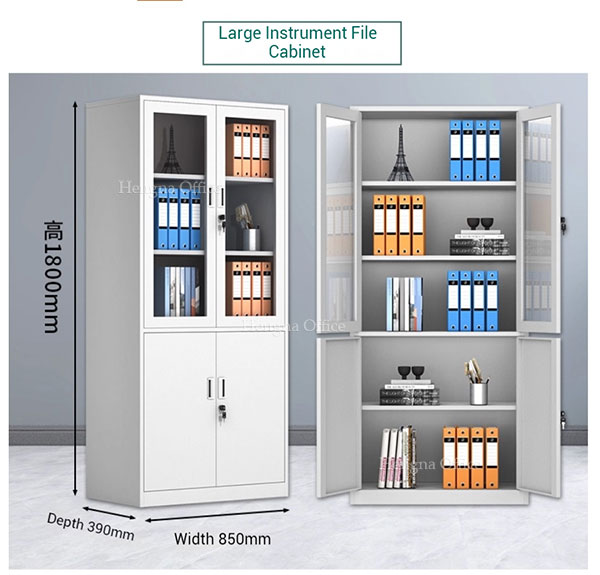
Doctors do not want to walk back to reception for every file. Treatment rooms work best with a compact instrument cabinet close to the chair — a unit for the active charts of the day plus clean storage for instruments and supplies. This is where our instrument cabinet line (H1800 × W850 × D390 mm) is used: tempered glass door, adjustable shelves, and a lock. “See it, grab it, lock it” is the workflow it is built for.
3. The records room or archive
Every practice accumulates files it must keep for years. The archive needs vertical density more than anything else — as many shelves as possible in the floor space available. Our five-section archive cabinet answers this: each section is a single unit (H390 × W900 × D400 mm), and sections stack to a full H2000 mm cabinet. Buy five sections now, add five more next year; the modules are identical, so growth does not mean replacing the system. For facilities that ship cabinets from overseas, each section packs to 0.044 m³ — a container that holds assembled cabinets will hold roughly twice as many of these flat-packed.
4. The laboratory and pharmacy
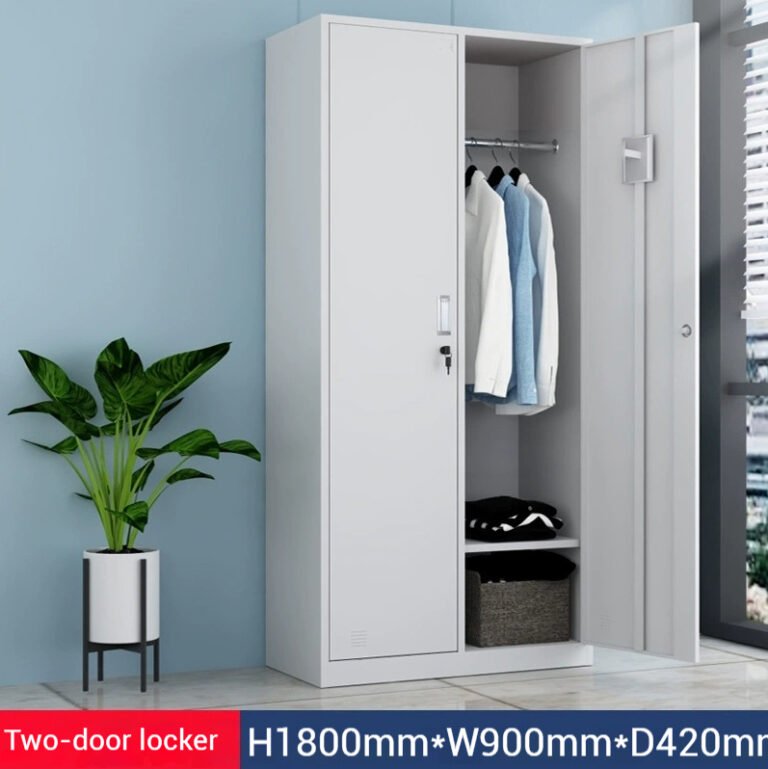
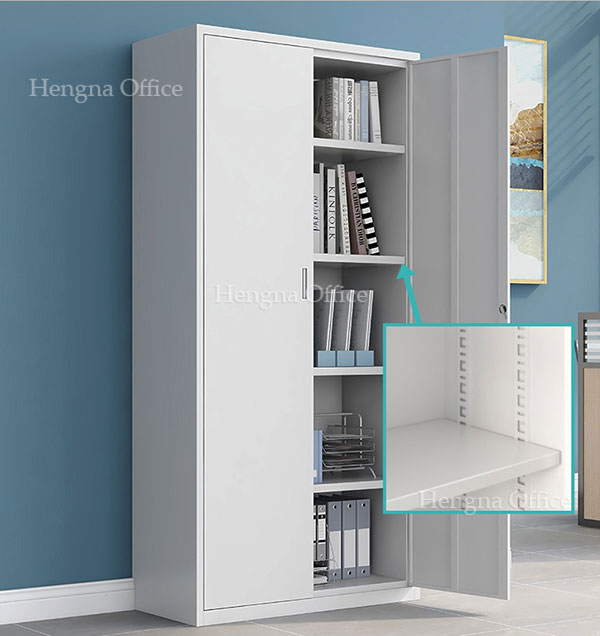
Lab and pharmacy storage is a different problem: boxes of supplies, temperature-sensitive stock, reagents that must not mix. A plain steel cabinet with adjustable shelves handles it — wipe-clean, no absorbent surfaces, and a lock for controlled items. Our standard filing cabinet with adjustable shelves (001) is the workhorse here, and the same cabinet in grey-white or pure white fits a clean-room aesthetic without looking out of place.
Quick-Reference: Which Cabinet for Which Room
| Room | Configuration | Why it fits |
|---|---|---|
| Front desk / reception | 2-drawer glass-door cabinet, H1850 × W900 × D400 | Glass shows organisation, drawers hold active files, lock secures overnight |
| Consultation room | Instrument cabinet, H1800 × W850 × D390, tempered glass | Compact beside the chair, visible stock, one key |
| Records room / archive | Five-section stackable archive, H390 per section → H2000 stacked | Vertical density, expandable in identical modules |
| Lab / pharmacy | Filing cabinet with adjustable shelves, H1850 × W900 × D400 | Wipe-clean steel, flexible shelving, lock for controlled items |
What All Four Have in Common
Steel, not board
Medical environments get wiped down, splashed, and sometimes flooded. Particleboard swells at the base and holds odours; steel does not. Every cabinet in this range is cold-rolled steel with electrostatic powder coating — the same coating process used for outdoor equipment — so the surface stays smooth and the cabinet keeps its shape in humid climates from the Gulf to Southeast Asia.
A lock that actually gets used
A lock is pointless if staff cannot use it quickly. We fit steel locks with keys on all medical configurations; the glass-door and instrument models take one key for the whole unit, so closing up at night is a single turn. For larger orders, keys are numbered and grouped by floor or department — something clinics with multiple rooms tell us they wish they had asked for earlier.
Flat-pack shipping without flat-pack quality
Every unit ships KD (knock-down), flat-packed with corner protectors. One person assembles a cabinet with basic tools and the illustrated instructions we include — no specialist installer, no crane. Because the packaging is dense (a tall cabinet packs to about 0.14 m³), shipping costs per unit drop sharply on container loads, which is why project buyers doing 30–100 cabinets at a time choose this line.
Three colours, one system
The range comes in grey-white, curry-white, and pure white. The structural spec is identical across colours, so a clinic can colour-code by department — white for front desk, grey for records, curry for pharmacy — without mixing incompatible furniture.
Buying Checklist for Clinics and Hospitals
When you compare quotes, run these five checks:
- Is the lock steel, and are keys numbered for large orders?
- Is the surface powder-coated steel rather than painted or laminated board?
- Do glass doors use fully tempered glass?
- Are the shelves adjustable without tools (or with a single tool)?
- What is the packed volume per unit — flat-pack or assembled?
Send us your room dimensions and file volumes; we will suggest the configuration and confirm the quantities in the quotation.
FAQ
Can you match a specific room size or file format?
Yes. Dimensions, shelf spacing, and drawer layouts are adjustable, and we make flat-file and letter-size options to order. If your archive uses a non-standard box, tell us the dimensions and we will confirm the fit in the quotation.
How many files does one cabinet hold?
It depends on whether you store hanging files, box files, or folders. As a rough guide, a 1850 mm cabinet with adjustable shelves holds several hundred folders; for exact capacity with your file type, send us a sample dimension and we will calculate it.
Do you supply lockable options for controlled or scheduled substances?
Yes — every configuration in this range can be supplied with a lock, and the filing cabinet with adjustable shelves is commonly used for controlled stock in pharmacies. For temperature-critical storage you would need a purpose-built unit, which is outside this range.
What is the lead time and minimum order?
Minimum order is one unit, so you can test a single cabinet before outfitting the whole facility. Quotations are usually sent within 24 hours; lead time and freight cost depend on your port and order size, so confirm these in the quotation. OEM is available — your logo on the door, custom packaging, and your choice of colour.
Factory Direct, One Supplier for the Whole Building
We are the factory — Luoyang Hengna, in the Pangcun steel furniture zone of Henan, China. One supplier for reception cabinets, records storage, pharmacy shelving, and staff lockers means consistent colour, consistent steel, and one freight consolidation instead of four. If you are fitting out a clinic or hospital wing, send the floor plan; we will work out the cabinet list and ship it flat-packed to your site.