How Many Cubbies Does a Daycare Need? A Formula for ABS Nursery Lockers
Every daycare director hits the same wall a few weeks before opening: how many cubbies do we actually need to buy? Order too few and parents are cramming bags into the hallway. Order too many and half the storage sits empty, eating floor space that could hold a play mat.
The answer is not a guess. It is a simple count: how many children are in the building at the busiest moment, plus a small buffer. This guide walks through the formula, shows worked examples for four common daycare sizes, and explains why ABS plastic — not steel, not wood — is the material most nurseries settle on.
The Formula in Three Steps
Step 1: Count the busiest hour
Do not use enrolment numbers. Use the number of children physically in the building at the busiest time — usually mid-morning, when drop-off is done and the afternoon session has not left yet. For a centre running a morning and an afternoon shift with staggered pickups, that number can be higher than either shift’s headcount. Write it down; this is your working number.
Step 2: One cubby per child, plus spares
Each child needs one cubby for a bag, spare clothes, and a drink bottle. Add spare cubbies for new enrolments mid-year and for trial days. As a rule of thumb: busiest-hour headcount + 10%. Round up.
Step 3: Divide by doors per cabinet
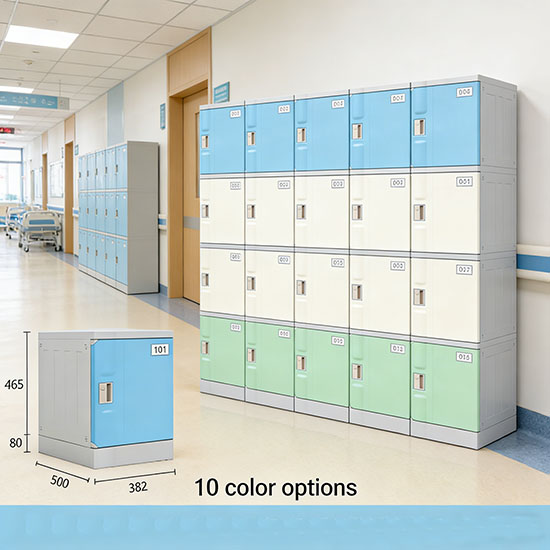
Divide the total by the number of doors on one cabinet, then round up to the nearest whole cabinet. Our ABS range comes in 3, 6, 9, 12, 15 and 18-door configurations, so a small centre can match the count almost exactly instead of over-ordering a whole bank.
Why the busiest hour, not enrolment, is the right base
Enrolment overstates what a room needs, and peak headcount understates it. A centre with 60 enrolled children may run a morning group of 40 and an afternoon group of 45 with a two-hour overlap — meaning 85 children are on site at 11 a.m. even though nobody ever enrols 85. Working from the overlap number means every child has a cubby during the crowded handover window, which is exactly when bags end up on the floor.
Worked Examples
| Centre size | Busiest-hour children | Cubbies needed (+10%) | Suggested configuration |
|---|---|---|---|
| Small in-home nursery | 20 | 22 | 2 × 12-door (24 doors) |
| Single-classroom daycare | 40 | 44 | 5 × 9-door (45 doors) |
| 4-classroom centre | 150 | 165 | 14 × 12-door (168 doors) |
| Large preschool chain site | 300 | 330 | 37 × 9-door (333 doors) |
These are starting points, not gospel. If your centre separates by age group — babies, toddlers, pre-schoolers — you may want a lower, shallower cabinet for the toddler room and a taller one for the pre-school room. That is exactly why the range offers heights from 860 mm to 1940 mm in the same door widths, so rooms can be fitted without mixing incompatible furniture.
Why Daycares Keep Choosing ABS
No formaldehyde, which matters more here than anywhere
Parents do not inspect your coating process; they smell the room. ABS is a single-piece injection-moulded plastic with no glued panels and no formaldehyde in the finished product. This is the first question we get from nursery managers, and it is the reason our kindergarten orders outnumber office locker orders every quarter.
It survives the cleaning schedule
A daycare is wiped down daily — sometimes twice. ABS handles disinfectant wipes and spray without swelling, peeling, or holding odour, the way painted metal and particleboard eventually do. Combined with the 80 mm raised base, the cabinet stays off the floor when the cleaner mops, so the bottom row does not soak.
Colour does real work
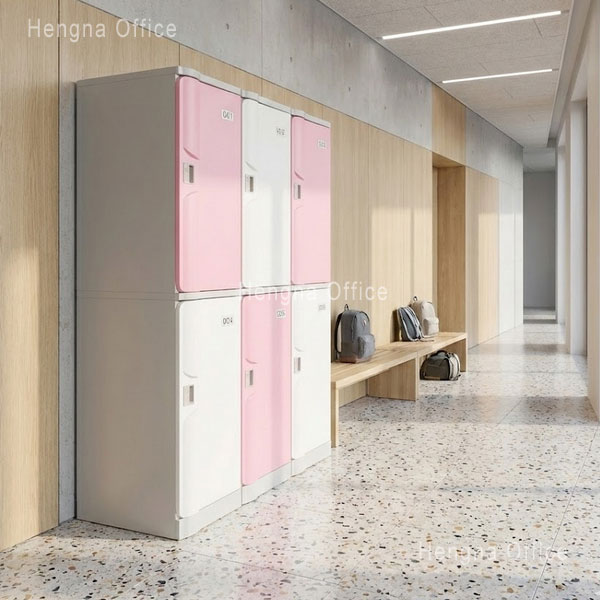
Eight standard colours let a centre colour-code by class: blue for the toddler room, yellow for pre-school, green for the after-school club. Children find their own cubby without reading names, and staff spot a misplaced bag from across the room. It is the cheapest organisation system you will buy.
Teachers can assemble it before lunch
No screws, no glue, no special tools. The cabinets interlock with a mortise-and-tenon fit, so two staff members assemble a full bank in an afternoon. For a room being fitted out over a weekend, that saves a call-out to a contractor.
Wood and painted steel: why they keep getting replaced
Wooden cubbies look warm in a showroom and are the first thing to go in a real nursery. They swell at the bottom from daily mopping, pick up smells from damp coats, and the particleboard cores in cheaper units hold odour no amount of wiping removes. Painted steel survives longer but chips where bags and shoes hit it, and the chips turn to rust in a wet room — which is the last thing you want at toddler height. ABS plastic lockers sit somewhere between: they do not swell, they do not chip to bare metal, and a scrape leaves the same solid colour underneath. That is why nursery suppliers who start with wood usually reorder in plastic within a year.
Match the height to the age group
A 1940 mm bank is fine for pre-schoolers and pointless for a toddler room. The range steps down through 1010 mm and 860 mm heights in the same door widths, so the under-threes get a low bank they can reach themselves — which, in a room where children fetch their own bottles, saves staff a hundred bends a day. Door widths from 290 mm to 480 mm handle everything from a narrow corridor wall to a wide cloakroom run, and combination banks can be built by joining standard units instead of ordering a one-off size.
Planning Checklist for Daycare Directors
- Count the busiest hour, not enrolment — and add 10%.
- Match door count to class size: 9-door banks for classes of 20-25, 12-door for 30-40.
- Order the 860-990 mm height for under-threes; 1010-1940 mm for older groups.
- Pick a colour per class and keep it consistent — it pays off every morning.
- Check the base: an 80 mm raised base on a wet-cleaned floor is not a luxury.
- Ask for a sample cabinet before committing to a full bank.
FAQ
How many cubbies per child is standard?
One cubby per child is the working standard, sized to hold a school bag, spare clothes and a bottle. Centres with a “rest time” policy sometimes add a second shallow shelf, but one full cubby per child covers the practical minimum.
Should cubbies be locked?
For under-fives, locks cause more problems than they solve — children lose keys, and staff need fast access during pick-up. Our daycare configurations use latches or padlock hasps on request; if your regulation requires locking, we can fit numbered locks for staff-managed use.
What if my room has a different shape?
Door widths of 290, 320, 382 and 480 mm cover narrow corridors and wide cloakroom walls. Send us the room plan and the headcount, and we will confirm a layout and the exact cabinet count in the quotation.
Can I get the logo or colour of my franchise?
Yes. We do OEM — custom colours, silk-screen or moulded logos, and packaging with your branding. Lead time and minimum order are confirmed per project; quotations normally go out within 24 hours.
Do you supply the cabinets as single units or joined banks?
Both. Standard cabinets can be ordered as independent units — useful when a room changes layout — or as linked banks where units share a side panel, which is cheaper for a whole-classroom order and is what most school and nursery buyers choose. Tell us which you need and we will confirm both options in the quotation.
Factory Direct for Your Whole Centre
We manufacture ABS and steel storage at our plant in Luoyang, China, and ship flat-packed in export cartons. One supplier for cubbies, staff lockers, and storage means one colour standard and one freight consolidation. If you are fitting out a new nursery or replacing the old wooden bank, send the headcount and room dimensions — we will come back with the cabinet list.