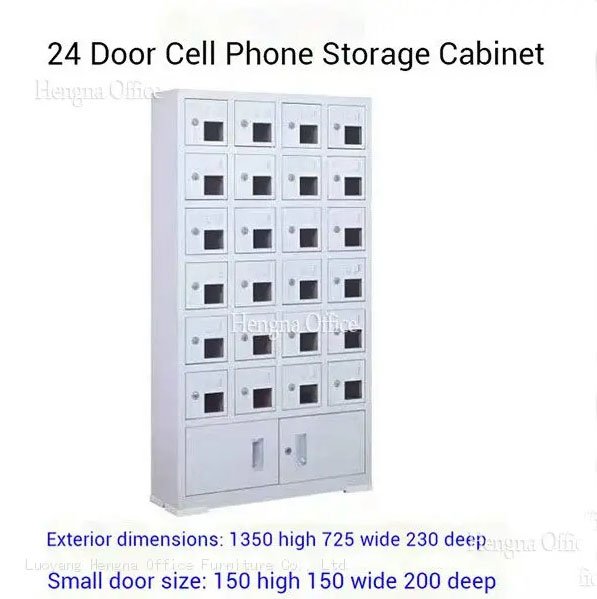
Phone Charging Lockers for Exam Centers: 30-Door Secure Storage with AC Charging
Every exam centre has the same fifteen minutes. Candidates queue at the door, phones in hand. A supervisor stands at a table with a cardboard box or a plastic tub, calling out names, scribbling numbers on sticky notes, and hoping nobody’s device gets mixed up at the end of the day. In a session with 150 candidates, that box becomes a security risk and a logistics problem at the same time.
A phone charging locker turns that fifteen minutes into a routine. One phone per slot, one lock per door, one charging point per compartment — and at the end of the session, every device comes back to the right candidate because every compartment is identified. Here is how the day runs with a 30-door charging cabinet, and what to check in the spec.
Part 1 — Before the Exam: Registration and Allocation (T-minus 60 to 15 minutes)
The cabinet’s job before the exam starts is to take phones in quickly and record who owns what, without a queue forming.
One phone per compartment, identified by card slot
Each door on our 30-door cabinet carries a raised card slot. The candidate slides their ID or a numbered card into the slot, and the compartment becomes theirs for the session. No sticky notes, no marker pens, no names shouted across the room. The supervisor can see at a glance which compartments are taken and which are free.
A compartment sized for any phone
Each compartment measures 150 × 150 mm — deep enough for a phone with a thick case, a power bank, or small personal items the candidate does not want in their pockets during the exam. The 30-door cabinet arranges as 5 columns × 6 rows, so a single unit holds a 150-180 candidate session comfortably, and two cabinets side by side cover larger halls.
Part 2 — During the Exam: Isolation and Charging at the Same Time
This is where a charging cabinet earns its keep over a plain storage box.
Phones stay out of reach — visibly
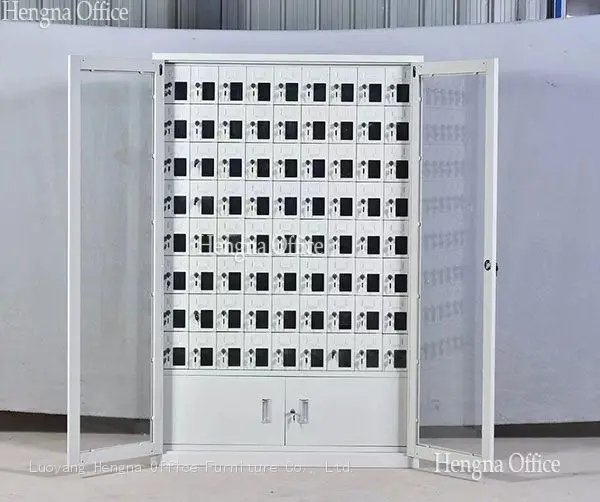
Our standard cabinet uses solid steel doors; the glazed option adds a high-transparency acrylic window so a supervisor can confirm a phone is inside without opening every door. For exam discipline, the acrylic window model is the practical choice: it keeps the room calm because candidates can see their device is safe, and it keeps supervision fast.
Locks matched to how the centre runs
The cabinet supports several lock types — key locks, PIN electronic locks, card locks, and fingerprint locks — and they can be mixed on the same cabinet. For exams, PIN or card locks are the common choice: no keys to hand out and collect, and a lost key can never delay a candidate. Confirm the lock set for your centre in the quotation.
Devices charge while candidates work
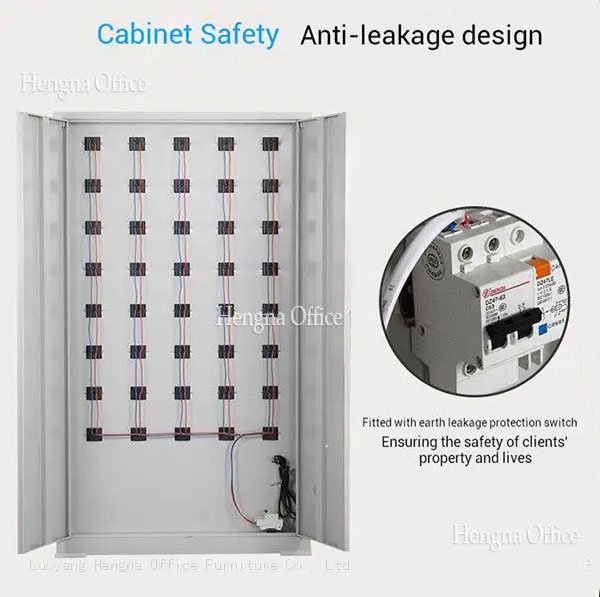
Each compartment has a charging point — 220V AC sockets (Chinese standard 5-hole or 4-hole, other voltages on request) or USB ports, or a mix. A candidate who hands in a phone at 30% walks out at 90%. The socket modules use branded components and support Type-C on request.
Part 3 — After the Exam: Fast, Error-Free Collection
Collection is where boxes of phones fail: devices get swapped, chargers get mixed, someone’s phone goes home with someone else. With identified compartments the process is mechanical:
- Candidates line up by row (5 columns × 6 rows means short, orderly queues).
- The supervisor unlocks each compartment against the numbered card slot, or candidates enter their own PIN.
- The phone is checked against the slot card on the spot, before the candidate steps away.
No sorting, no ‘whose is this’ at the door, no lost-device reports after the session.
Safety Spec — What Protects 30 Phones on One Cabinet
Charging 30 devices from one cabinet is only acceptable if the electrical side is engineered for it. The cabinet is built with three layers of protection, and the wiring details are not marketing talk:
- Leakage protection: a residual current device trips within milliseconds if leakage current exceeds the safe threshold (30 mA), cutting power to the cabinet.
- Short-circuit protection: a circuit breaker trips automatically on abnormal voltage or current.
- Overload protection: the breaker system cuts the circuit if total load exceeds capacity.
- Wiring: 2.0 mm solid copper conductors throughout — no aluminium wire — with colour-coded live, neutral and earth lines fixed neatly inside the back panel.
The cabinet body is cold-rolled steel with electrostatic powder coating, supplied fully assembled — unpack, place against a flat wall, connect the grounded power supply, and it is ready for the first session.
Spec Quick View (30-Door Phone Charging Cabinet)
- Door count: 30 (5 columns × 6 rows)
- Compartment: 150 × 150 mm per slot
- Standard model: 1125 (H) × 900 (W) × 300 (D) mm
- Glazed model with base plinth: 1400 (H) × 950 (W) × 350 (D) mm, acrylic viewing windows
- Charging: 220V AC sockets (5-hole / 4-hole), USB options, Type-C on request
- Protection: leakage + short-circuit + overload, 2.0 mm copper wiring
- Locks: key / PIN / card / fingerprint, mixable on one cabinet
- Identification: raised card slot on every door
- Delivery: fully assembled, unpack and use
- Warranty: 1 year free, lifetime paid repair service; quotation within 24 hours
FAQ
What phone charging locker should an exam centre buy?
Look for three things: a compartment with a card slot for identification, a lock type that matches your supervision flow, and charging that is safe to run in volume — leakage protection, short-circuit protection and overload protection. The 30-door cabinet covers a 150-180 candidate session in one unit.
Is it safe to charge 30 phones from one cabinet?
Yes, when the cabinet is engineered for it. Ours uses a residual current device, circuit breakers and a rated wiring system — confirm the exact electrical configuration for your market in the quotation.
20 doors or 30 doors — which do I need?
Size the cabinet to the peak session, not the average. A 20-door unit suits classes and small training rooms; a 30-door unit handles exam sessions and larger groups. Two 30-door cabinets cover a full hall without blocking the aisle.
Are the cabinets delivered assembled?
Yes. Phone cabinets are shipped fully assembled — unpack, connect the grounded power supply, and use. No assembly, no loose parts, no electrician needed beyond connecting the supply.
Can the cabinet be customised?
Yes — door counts, lock types, socket layouts (AC / USB / Type-C mixes), colours and logo printing are all available on request. Tell us how your exam sessions run and we will confirm the configuration within 24 hours.
We build phone charging cabinets at our plant in Luoyang, China, and export worldwide. Exam centres, language schools, certification bodies and training academies order from us directly — send your session numbers and we will size the cabinet bank for you.