Stainless Steel Lockers for Coastal Gyms: A Salt-Air Spec Checklist
A gym by the sea looks great in the marketing photos. What the photos never show is what the locker room looks like eighteen months later. Salt air, high humidity, air-conditioning condensation and members coming straight off the beach put a locker room through a cycle that a dry inland gym never sees. Rust speckles appear on the doors. The bottom edges of the cabinets show the first orange freckles. The insides start to smell if air cannot move.
If you are outfitting a coastal gym, a resort fitness centre or a beachside sports club, the locker spec you choose decides how the room looks in year two and how much maintenance it swallows in year three. This guide walks through what salt air does to lockers, what the spec sheet should contain for a seaside location, and what to do once the cabinets arrive.
Part 1 — What Salt Air Actually Does to Lockers
Salt air is not ordinary humidity. It is a combination of three separate attacks, and each one hits a different part of the locker.
1. Salt particles settle and hold moisture against the steel
Sea breeze carries microscopic salt crystals inland. They settle on every horizontal surface — locker tops, door edges, handle recesses. Salt attracts and holds moisture, so even on a dry day the surface stays slightly damp. Over months, that damp film is what starts surface corrosion on steel that is not stainless.
2. Air-conditioning condensation drips where you cannot see it
A gym runs its AC hard. Condensation forms on the cabinet tops and drips down the sides, pooling at the base. In a coastal location the pooled water is salty water. The bottom 10–15 cm of the cabinet takes the worst of it.
3. Sealed compartments trap humid air
A locker that stays closed holds damp air from wet training clothes. Without ventilation, the inside soon smells and the surfaces mark — which is why ventilation slots matter more in a humid seaside gym than in a dry inland office.
Part 2 — What the Spec Sheet Should Include for a Seaside Location
When you compare quotations, look for these six items specifically. Each one answers one of the problems above.
1. Material grade, stated honestly
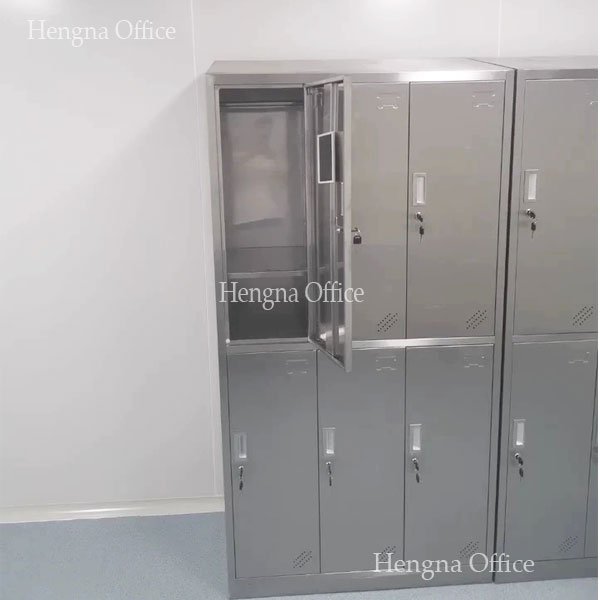
Stainless steel is the material that answers salt air, because its surface does not carry a coating that can chip and expose bare steel underneath. Our standard production is Type 201 stainless steel, available from stock and supplied fully assembled — it is the grade used in our 9-door school model and our food-industry lockers. Type 304 stainless steel, the higher-corrosion grade, is available on request as a custom order for the most severe salt exposure — confirm the grade and quotation for your location.
2. A full-steel cylinder lock with two keys
Salt air attacks lock mechanisms too. A full-steel cylinder lock, supplied with two keys per door, keeps the locking system simple and serviceable — no electronics to corrode, no battery to fail in a humid room. That is the lock fitted across our stainless locker range.
3. Dual-row ventilation slots per door
Ventilation is the quiet hero in a coastal locker room. Dual-row long vents on each door let air move through the compartment, so wet kit dries instead of festering and the inside stays fresher. This is standard on our stainless lockers and it is worth insisting on for a seaside site.
4. A transparent label holder on every door
With members and staff rotating through a busy gym, labelled compartments save the front desk a lot of confusion. A transparent label holder on each door lets you print names or numbers without sticking tape to the stainless surface.
5. Interior layout matched to how the room is used
A single shelf fits backpacks, gym clothes and a water bottle. A hanging rod suits staff uniforms and coats. Our stainless lockers are configured either way, and the 6-door and 9-door layouts offer deeper compartments for bulkier gear. Choose the interior that matches your members’ habits rather than the cheapest default.
6. Door count sized to the room, not to the catalogue
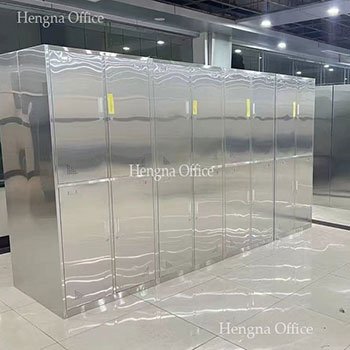
Our stainless locker range runs from 2 to 32 doors, in single rows or blocks, with an overall height of 1800 mm and depth of 420 mm. A 9-door unit (3×3) suits a small class or staff group; a 24-door block handles a busy member flow. Sketch the room, count the peak users, and size the bank to the peak — not to the average.
Part 3 — After Delivery: A Maintenance Plan That Matches the Coast
Stainless steel is low-maintenance, not no-maintenance. In a coastal location the plan is simple and it protects your investment:
- Acceptance check on delivery: unpack and inspect every door, lock and vent before installation, so anything that travelled badly is noted while it is still our responsibility.
- Routine wipe-down: clean the stainless surface with a mild cleaner and a soft cloth. Avoid abrasive pads and bleach-based products, which dull the brushed finish over time.
- Salt-film rinse: where the room is close to the beach, rinse the exterior with fresh water and dry it periodically. It takes minutes per bank and it stops salt crystals from sitting on the surface.
- Keep vents clear: check that the ventilation slots are not blocked by stickers, bags or dust — the airflow is what keeps the interiors dry.
- Oil the cylinder locks: a light, regular application of lock lubricant keeps the full-steel cylinders turning smoothly in humid air.
That is the whole maintenance story. No repainting, no rust-treating, no door replacement programme.
Spec Overview (Our Stainless Locker Range)
- Overall height 1800 mm, width 900 mm, depth 420 mm (6-door and 9-door blocks)
- Door count from 2 to 32, sized to the room
- Body: Type 201 stainless steel from stock; Type 304 available on request (custom order)
- Surface: brushed, matte finish
- Lock: full-steel cylinder, two keys per door
- Ventilation: dual-row long vents per door
- Identification: transparent label holder on each door
- Interior: 1 shelf, or hanging rod — configurable
- Delivery: fully assembled, unpack and use
- Certification: CE
FAQ
Do stainless steel lockers rust in coastal areas?
Stainless steel resists corrosion, which is exactly why it is the sensible choice for salt air. The degree of protection depends on the grade and the severity of the exposure — our standard 201 grade covers normal humidity and coastal gym conditions well; for extreme salt exposure, Type 304 is available on request and we will confirm the right grade with you before quoting.
Type 201 or Type 304 — which do I need for a seaside gym?
For most gym and resort locker rooms, Type 201 from stock is the practical, cost-effective choice. If your building sits directly on the waterline or you already see heavy salt film on surfaces, ask us for the Type 304 custom order. Send us the location and we will advise honestly — we would rather you order the right grade once.
Why do the lockers need ventilation slots in a gym?
Because wet training clothes go inside and the door stays closed. Dual-row vents let humid air move through the compartment instead of condensing inside, which keeps the locker fresher and the contents drier.
Are the lockers delivered assembled?
Yes. Our stainless steel lockers are fully assembled, wired where applicable and tested at the factory, then packed so they arrive ready to use — unpack, place, and open for business.
Can I order a sample before a full bank?
Yes, sample orders are welcome. Send your locker room plan and your numbers — door count, interior layout, material grade — and we will confirm the configuration and quotation within 24 hours.
We manufacture stainless steel lockers at our plant in Luoyang, China, with CE certification, OEM branding and export packing for sea freight. Coastal gyms are a specialty — tell us where the lockers are going, and we will confirm the grade and configuration that fits the salt air.