Steel or ABS Lockers for a Swimming Pool: Which One Survives the Humidity
When it’s time to replace lockers in a swimming pool changing room, the first question that comes up is always the material. Steel lockers cost less. ABS lockers don’t rust. Which one’s actually worth it?The answer isn’t simple. It depends on your pool’s humidity, your budget, and how many years you plan to keep them. I’ve worked with steel furniture for over a decade and dealt with clients who’ve used both — so here’s what I’ve seen.
How Long Do Steel Lockers Last in a Swimming Pool
Let’s start with steel, since it’s the most common choice.
The advantage is clear — price. For the same size, steel lockers typically cost 30–40% less than ABS. If your budget is tight, steel is the economical option.
But the fatal weakness in a pool environment is rust. It’s not a question of “if” — it’s “when.”
Swimming pool changing rooms sit at 70%+ humidity year-round. Near the showers, it hits 90%. Powder coating on steel works fine in dry environments, but under constant moisture, water vapor seeps in through seams, corners, and screw holes. The coating starts separating from the inside. By the time you see rust spots on the surface, the corrosion underneath has already been going on for a while.
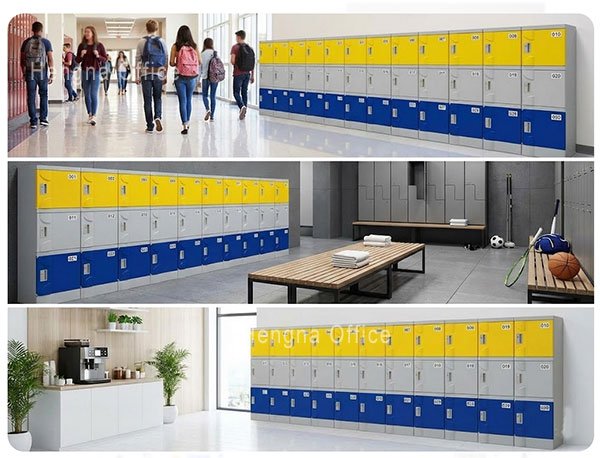
Based on customer feedback and real-world use, here’s what the timeline looks like:
| Time frame | Condition of steel locker |
|---|---|
| 0–6 months | Looks normal, coating intact |
| 6–12 months | Small rust spots appear at seams and corners |
| 12–24 months | Spots spread, locker feet start corroding, some doors stick |
| 24–36 months | Rust holes form, feet deform, hinges seize — replacement needed |
This isn’t an isolated case. It’s the cycle almost every facility using steel lockers goes through. The cumulative maintenance cost over three years — rust removal, touch-up painting, hinge replacement — can end up higher than the cost of ABS lockers from the start.
How Long Do ABS Lockers Last in a Swimming Pool
Now let’s talk about ABS.
The core advantage is simple: no rust. Not “rust-resistant” — there’s simply no metal to oxidize. ABS engineering plastic, nylon hinges, wear-resistant door pins. All non-metal materials. In a high-humidity environment, there’s nothing to corrode.
The downside is upfront cost. Same size, ABS lockers run 30–40% more than steel. That’s what makes buyers hesitate.
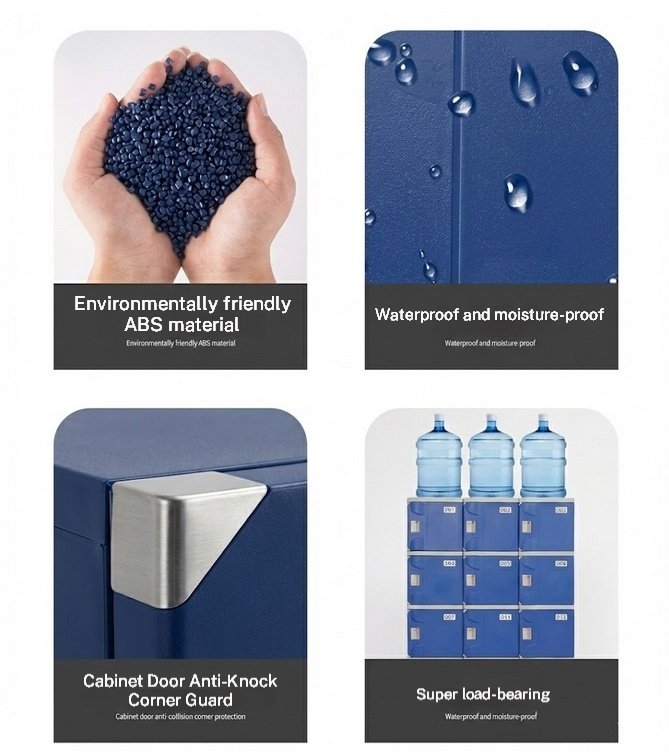
But if you look at the total cost, ABS may actually be cheaper. Steel lockers need replacing every 2–3 years. ABS lockers in a pool environment hold their appearance for 5–6 years with minimal change. Over six years:
| Steel locker | ABS locker | |
|---|---|---|
| Unit price | Lower | Higher (+30–40%) |
| Lifespan in pool environment | 2–3 years | 5–6 years |
| Replacements over 6 years | 2 times | 1 time |
| Maintenance cost (rust removal, repainting, hinges) | Yes — adds up over 3 years | Almost none |
| Total 6-year cost | May exceed ABS | May be lower than steel |
Five Dimensions of Comparison
| Comparison factor | Steel locker | ABS locker |
|---|---|---|
| Moisture resistance | Powder coating resists moisture, but seams and screw holes let water in | Entirely non-metal, no water penetration, no rust |
| Mold | No mold if coating is intact; once damaged, metal surface grows bacteria | Non-porous plastic surface doesn’t absorb water, no mold |
| Hinge lifespan | Metal hinges — may stick within 1–2 years in high humidity | Nylon hinges — no sticking in high humidity |
| Cleaning | Acidic disinfectants eat into the coating | Acid and alkali resistant — disinfectants don’t affect it |
| Installation | Requires screwdriver and tools | Mortise-and-tenon joints, hand assembly only |
When to Choose Steel, When to Choose ABS
Not every swimming pool should go with ABS. Here’s my take:
Choose steel lockers if:
- Budget is genuinely tight, with no room for higher upfront cost
- The changing room has good ventilation and humidity stays below 60% (with a dedicated dehumidifier system)
- Short-term use — a temporary facility you’ll tear down in 1–2 years
- You have a maintenance team on staff that can handle regular rust removal and repainting
Choose ABS lockers if:
- Changing room humidity is consistently above 70% (this is most swimming pools)
- You don’t want to replace lockers every 2–3 years
- Daily disinfection means cleaning chemicals are used frequently
- No dedicated maintenance staff, or maintenance budget is limited
Quick test: Stand in your changing room. If the air feels sticky with moisture on your face — go with ABS. If the room feels dry and comfortable with good airflow — steel can work.
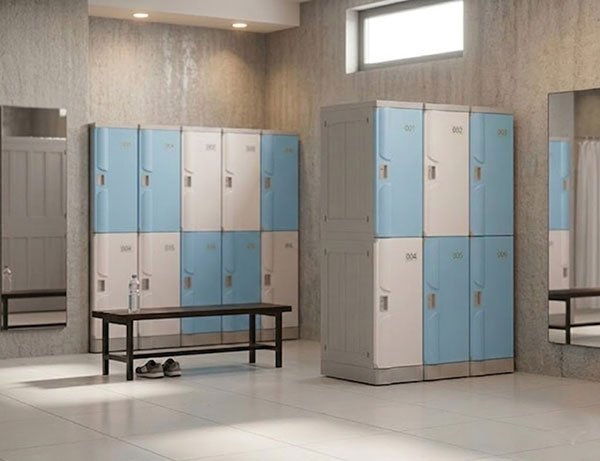
ABS Lockers for a Swimming Pool Real Scenario Comparison
Scenario A: Community pool (50 users/day, no dehumidifier)
- Steel lockers: Rust appears at 18 months, widespread corrosion by year 2, replaced in year 3
- ABS lockers: Appearance largely unchanged after 3 years, no maintenance needed
- Verdict: Go with ABS
Scenario B: High-end gym pool (central dehumidifier, humidity controlled at 55%)
- Steel lockers: Good condition for 3 years, minor rust spots start appearing in year 4
- ABS lockers: Work fine, but steel is already sufficient
- Verdict: Either works — if budget is tight, steel is acceptable
Scenario C: Hotel spa pool (90%+ humidity, elevated temperature)
- Steel lockers: Rust spots within 12 months, twice as fast as a standard pool
- ABS lockers: Completely unaffected
- Verdict: ABS, no question
Frequently Asked Questions
Q: Will ABS lockers degrade in sunlight?
Prolonged UV exposure does accelerate plastic aging. But pool changing rooms are indoor environments — this isn’t an issue. If you’re placing them outdoors, add a shade structure.
Q: Can reinforced coating make steel lockers rust-proof?
Better coating delays rust, but doesn’t prevent it. Water vapor still gets in through screw holes and seams. Some clients tried stainless steel lockers — at 3x the cost of regular steel — and still saw rust spots after 5 years. “Stainless” doesn’t mean rust-proof.
Q: Can I mix ABS and steel lockers?
Yes. Some pools use [ABS plastic lockers] in the main changing area and steel cabinets in dry office or storage spaces. Choose materials by zone — control cost where you can, protect quality where it matters.
Q: Are nylon hinges durable enough?
For normal use, yes. A locker in a pool changing room gets opened 20–30 times a day. Nylon handles that without issue. Extreme abuse (kicking the door) is another story.
Q: How do I know my changing room’s humidity level?
Simplest method: buy a hygrometer, leave it in the changing room for three days, and take the average. Above 70% — go ABS. Below 60% — steel can work. Between 60–70% — decide based on budget.
Still torn between steel and ABS? [Contact us] — tell me your facility type, humidity level, and budget, and I’ll give you a straight answer.