Anti Tip Flat File Cabinet 5 Drawer A0 — Drawer Stops Lock Open on Uneven Floors, Jobsite Ready
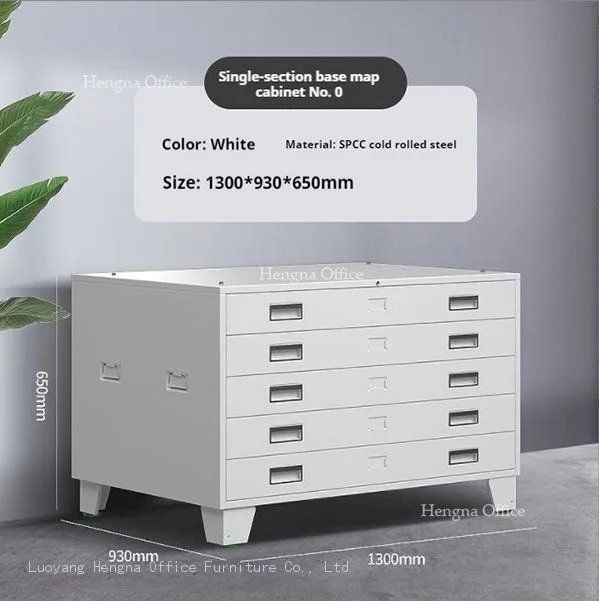
Anti Tip Flat File Cabinet 5 Drawer A0 Specs
| Item | Specification |
|---|---|
| Product | A0 Flat File Cabinet / Blueprint Cabinet |
| Material | SPCC cold rolled steel |
| Finish | Phosphate pretreatment + electrostatic powder coating (white, other colors available) |
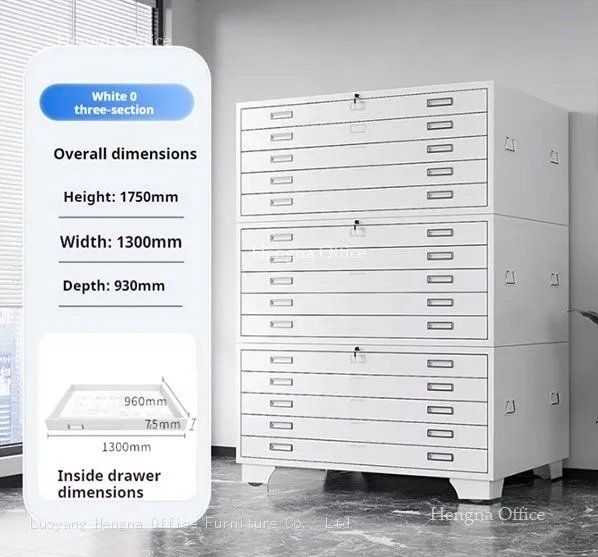
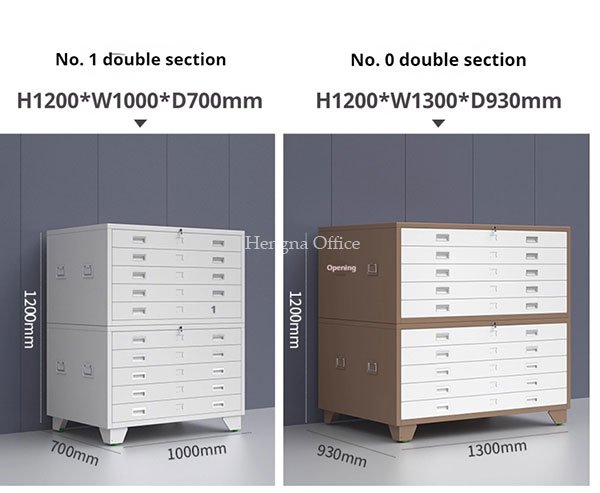
| Overall Dimensions | W1300 × D930 × H650 mm (51.2×36.6×25.6 in) |
| Drawers | 5 |
| Drawer Interior | W1240 × D870 × H80 mm (48.8×34.3×3.1 in) |
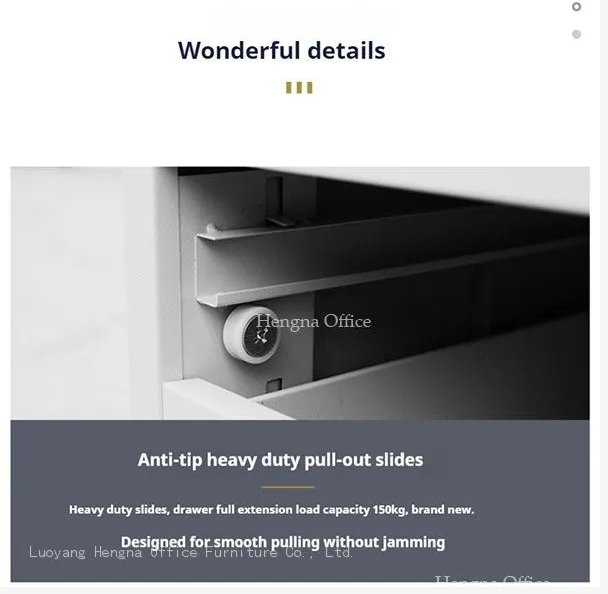
| Load Capacity Per Drawer | 150 kg (330 lbs) at full extension, static load |
| Slides | Three-section heavy duty slides, full extension, auto-locking stops |
| Anti-Tip Design | Weighted base + calculated center of gravity + self-locking drawer stops |
| Base | Four independently adjustable leveling feet |
| Label Slots | Integrated card slots on drawer faces |
| Lock | Central lock, one key locks all five drawers (standard) |
| Packaging | Fully assembled, moisture barrier wrap + corner protectors + reinforced carton |
| Warranty | 1 year on full unit |
Jobsite Cabinets Are Not Office Cabinets
Before you buy a cabinet, look at where it’s going to live.
An office floor is level. The wall is solid. Anchoring the cabinet to the wall is a real option. A jobsite trailer floor? Poured weeks ago, often not level. Concrete bulges in the middle and dips at the edges, or the reverse. One of the four cabinet feet is almost always floating.
And the field office moves. When the project wraps, the trailer goes to the next site. The anchor holes you drilled are gone with the old floor.
In that environment, “bolt it to the wall” isn’t a long-term solution. It’s a temporary patch.
Our approach: the structure itself doesn’t tip. No floor conditions required.
Anti-Tip Isn’t Anchors. It’s Structure.
Three layers.
Layer 1: Weighted base. The base plate is thicker and heavier than industry standard. The center of gravity sits low. An empty cabinet is already more stable than a comparable cabinet from anyone else. A loaded one is even more planted. This isn’t “slap a heavy plate on the bottom” — the weight placement and amount are calculated to keep the center of gravity inside the support footprint under any drawer load configuration.
Layer 2: Auto-locking drawer stops. When a drawer reaches full extension (about 900mm travel), an internal spring catch engages with the slide housing. The drawer locks in place. You push it, it doesn’t retract. You pull it, it doesn’t extend. To release it, push the drawer back about 2cm. The catch disengages, and the drawer slides normally.
Layer 3: Adjustable leveling feet. Jobsite floors are not level. If the cabinet’s four feet don’t sit flat, the structure is already compromised before you load anything. The four leveling feet on this cabinet adjust independently. Level the cabinet first, then the anti-tip design works as intended.
When Tip Risk Is Highest
Not the dramatic “yank a drawer” scenario. These are the four real situations:
One: searching for a drawing, both hands on the drawer front. Drawer fully extended, you’re bent over, looking through sheets. Your body weight rests on the drawer front edge. That’s when the center of gravity shifts farthest forward.
Two: the top drawer holds the most weight. The top drawer has the longest lever arm. If it’s also holding the most weight — say, a full set of structural drawings — the forward moment is at its maximum. Our factory tip test is run on this exact configuration: all five drawers open, top drawer loaded to 150kg, cabinet must not tip.
Three: floor isn’t level, three feet are taking all the weight. Routine on jobsites. If the cabinet isn’t leveled, the missing support from the fourth foot drops the tip threshold immediately. Leveling feet solve this. Use them.
Four: relocated and not re-anchored. A cabinet was bolted down at the last site. Moved to a new one. The new floor is concrete that can’t be drilled, or nobody bothered. The user thinks “it was anchored before, so it must be safe.” It’s not. This is more dangerous than never anchoring at all, because the user has a false sense of security.
150kg Load Rating and Anti-Tip Are Designed Together
Most buyers don’t think about this:
If a drawer is rated for 60kg, loading it to capacity warps the slides slightly. The drawer doesn’t reach full extension — the slides sag and stop short. Less forward reach means less tip risk. Cheap cabinet, “safe” by accident.
But if a drawer is rated for 150kg, the slides stay rigid under load. The drawer reaches full extension. Without an anti-tip structure, a high-capacity cabinet is more dangerous than a low-capacity one — it carries more weight farther forward.
That’s why the 150kg rating and the anti-tip design were developed together, not as separate specs. They have to work in combination to make sense.
How the Locking Stop Works
You don’t press any button.
Pull the drawer out. At full extension — a soft click — the spring catch engages. Drawer is locked. Push it, it doesn’t slide back. Pull it, it doesn’t extend. Both hands free. The drawer won’t drift closed while you’re searching through drawings.
When you’re done, push the drawer back about 2cm. The catch disengages. Drawer slides normally.
The design fits how you already use a cabinet. Pull, search, push. The only difference is an automatic safety catch you don’t have to think about.
What You Care About on a Jobsite
| What matters | What we built |
|---|---|
| Uneven floor? | Four independently adjustable leveling feet |
| Drawer pulls out all the way? | Full extension, about 900mm travel, A0 sheet completely exposed |
| Drawer bottom sag over time? | Stamped reinforcement ribs, even load distribution, no center dip |
| Need to move it? | Built-in carry handles on both sides, two-person move |
| Need to bolt to floor? | No — structure is self-stabilizing. Anchor holes on back panel are provided for special requirements |
| How are drawers labeled? | Integrated card slots on drawer faces, no adhesive |
| Assembly required? | None. Ships fully assembled |
Where This Cabinet Makes Sense
| Environment | Why Anti-Tip + Leveling Matter | Note |
|---|---|---|
| Jobsite trailer / project field office | Uneven floor, frequent relocation, no permanent anchoring | Primary design target |
| Architecture / engineering firm | Drawers opened multiple times daily, safety is a workflow need | Peace of mind |
| Manufacturing plant floor | Sloped or settled floors, heavy drawings | Leveling feet + anti-tip cover both issues |
| University / research lab | Students use the cabinet, safety awareness varies | Auto-lock safer than manual lock |
| Government archive / records office | Procurement requires safety compliance | Tip test documentation available on request |
About Us
Factory in Luoyang, Henan, China. We’ve been making steel cabinets for over a decade. We have an on-site counterweight test rig and a slide cycle tester — every production batch gets spot-checked for tip resistance. Domestic clients include engineering firms, design institutes, and government agencies. Export clients across North America, the Middle East, and Southeast Asia.
Anti-tip is a bigger concern for overseas buyers, especially in North America and Europe where OSHA and workplace safety standards treat it as a requirement. If your purchase goes through a tender or compliance review, we can provide structural calculation notes and tip test documentation.
A steel cabinet isn’t complicated. But the difference between one that works safely for years and one you learn to avoid — that’s in the specs most people only notice after buying the wrong one.
FAQ
Warranty? 1 year on the full unit. Slides, handles, and locks that fail under normal use within the warranty period are replaced at no charge.
Do I need to anchor it to the floor? No — the structure is self-stabilizing. Anchor holes on the back panel are provided for special cases (seismic zones, areas with children, regulatory requirements).
Will the locking stop break? The slide unit is cycle-tested well beyond daily use at the factory. If a stop mechanism fails within the warranty period, the complete slide assembly is replaced free of charge.
How much can the leveling feet adjust? Each foot adjusts about 15mm. That covers most jobsite floor irregularities. For larger drops, place a rubber shim under the cabinet first, then fine-tune with the feet.
How is it shipped? Fully assembled, moisture barrier wrap, corner protectors, reinforced carton. Regular sea freight routes to North America, Europe, and the Middle East. Inspect on arrival — if there’s transit damage, send us photos and we ship replacement parts at no cost.
Can you customize the height? Yes. Standard height is 650mm. A taller base (for desk-height use) is available, add 10-15 days to lead time.